
Skills Gap Widens Amid Rapid Industry Change
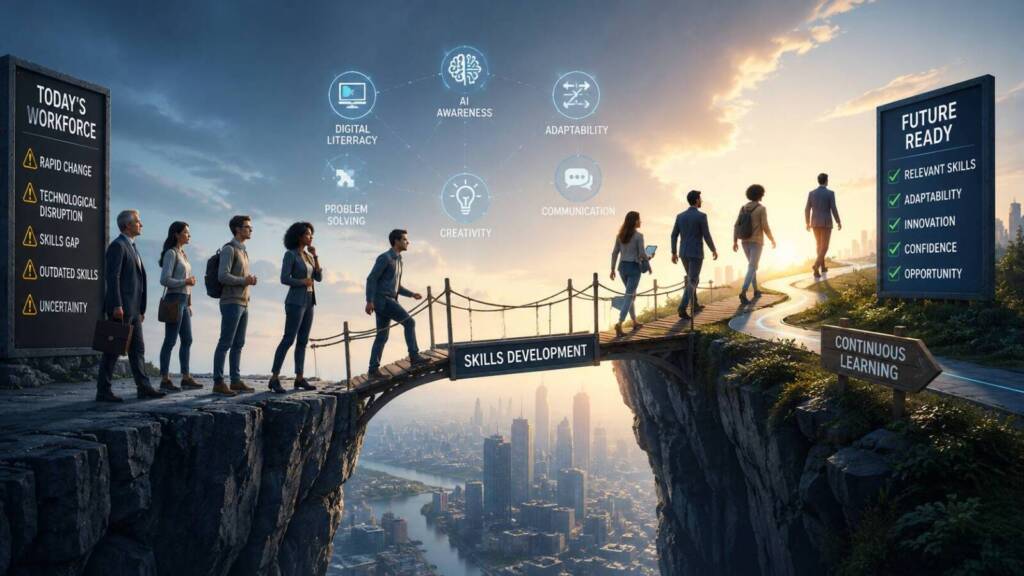
The workforce is facing a growing skills gap as industries change more quickly than many employees are able to adapt. New research from Arden University suggests that 58% of UK employees believe their sectors are changing at an accelerated pace, yet only 51% are actively learning new skills to keep up.
In Brief
Britain’s skills gap is widening as industries change faster than many employees are able to retrain, creating risks for employability, productivity and workforce planning. Separately, Acas research highlights a lack of mediation skills in many workplaces at a time when conflict is affecting employee wellbeing and motivation.
Key Points
- 58% of UK employees believe their sectors are changing at an accelerated pace, but only 51% are actively learning new skills to keep up.
- Technological disruption is the leading concern, with 47% of workers identifying it as a threat to job security.
- The skills gap is no longer limited to technical roles, as AI, automation and digital tools increasingly affect a broad range of jobs.
- Nearly half of employees are not currently upskilling, with some believing their existing skills are sufficient and others citing lack of time or motivation.
- Acas research found that one third of UK workplaces lack staff with mediation skills, rising to 40% among SMEs.
- Workplace conflict can damage wellbeing, motivation and productivity, making early intervention and mediation capability increasingly important.
That mismatch / skills gap matters. If roles, tools and working practices are changing faster than workers can reskill, the skills gap becomes a risk for both employees and employers. Individuals may find that their existing capabilities become less relevant, while businesses may struggle to recruit, retain and develop the talent they need.
Technology and the Skills Gap
Technology is now one of the main drivers of the skills gap. Almost half of workers identify technological disruption as a threat to job security, while others point to economic instability and the difficulty of keeping pace with changing skill requirements.

Artificial intelligence, automation and digital tools are no longer limited to specialist technical roles. They are increasingly affecting administration, customer service, finance, HR, marketing, professional services and operational roles. As a result, the skills gap is no longer just about a shortage of coders or engineers. Instead, the skills gap is about whether the wider workforce has the confidence and capability to work effectively as jobs change.
The pace of change is also shortening the useful life of many workplace skills. The average half-life of skills is now estimated to be under five years, with some skills becoming outdated much more quickly. That creates a significant challenge for employees who have relied on a stable skill set for much of their working lives.
Why Many Employees Are Not Upskilling
Despite growing concern about the skills gap, nearly half of employees are not currently engaged in any form of upskilling. Among those not developing new skills, 36% believe their existing abilities are sufficient, 25% say they have no desire to pursue further learning, and 20% cite lack of time.
For employers, those figures should be a warning. Some employees may not yet recognise how quickly their roles are changing. Others may understand the need to learn but feel unable to do so alongside workload pressures, caring responsibilities, shift patterns or lack of access to training.
There is also a risk of a two-speed workforce. Younger workers appear more likely to reskill than older colleagues, which may widen the skills gap between different age groups. If employers do not address this, some employees may become increasingly vulnerable to displacement, while others move ahead more quickly.

Why the Skills Gap Matters for Employers
The skills gap affects more than individual career prospects. It can reduce productivity, slow innovation and make it harder for employers to fill vacancies. Businesses may invest in new technology but fail to see the full benefit if staff are not confident or capable enough to use it effectively.
The skills gap as an issue is not only technical. While digital literacy and AI awareness are increasingly important, employers also need human skills such as adaptability, communication, creativity, judgement and problem-solving. These skills help employees navigate change, work with new tools and respond to uncertainty.
Employers should therefore treat the skills gap as a workforce planning issue, not simply a training issue. They need to understand which roles are changing, which skills are becoming outdated, and which capabilities will be needed in future.
One-off training is unlikely to be enough. Workers need flexible learning opportunities that fit around work, as well as clear guidance on which skills are most relevant to their current and future roles.

Closing the Skills Gap
Closing the skills gap will require action from employers, education providers and government. Businesses need to identify where capability is falling behind, provide accessible training, and encourage employees to see learning as part of working life rather than an optional extra.
Educational institutions and training providers also have a role to play in offering flexible routes into new skills, including short courses, modular learning and practical workplace-based training. Government policy will also be important, particularly where retraining is needed in sectors most exposed to automation or structural change.
The idea of a “job for life” has largely disappeared. Workers are more likely to move between roles, employers and even occupations during their careers. In that environment, the skills gap is not a short-term problem. It is becoming central to employability, productivity and long-term economic resilience.
One Third of UK Workplaces Lack Mediation Skills Amid Rising Conflict
A new Acas survey has found that one third of UK workplaces do not have staff with the mediation skills needed to help resolve internal conflict. Among small and medium-sized enterprises, the figure rises to 40%.
That is a significant skills gap. Workplace conflict is common, and when it is not handled early, it can escalate into grievances, sickness absence, resignations, tribunal claims and wider damage to morale.
Why Mediation Skills Matter
Mediation gives employers a way to address disputes informally before they become formal employment problems. It usually involves an impartial mediator helping those in conflict discuss the issue, understand each other’s position and agree a practical way forward.
It is not suitable for every situation. Serious allegations, discrimination complaints, whistleblowing issues or misconduct concerns may require formal investigation. However, many workplace disputes arise from communication breakdowns, personality clashes, misunderstandings, workload pressure or damaged trust. In those cases, mediation can be a valuable early intervention.
The benefit is that it allows issues to be addressed before positions harden. Employees may be more willing to speak openly in a facilitated conversation than in a formal grievance process. Employers may also be able to preserve working relationships that would otherwise deteriorate.

Conflict Is Affecting Employees and Businesses
The need for mediation skills is underlined by rising levels of workplace conflict, as Acas highlighted in an earlier survey. The survey found that 44% of UK workers reported experiencing disputes or disagreements at work. Of those affected, 57% said conflict increased their stress or anxiety, while 49% reported reduced motivation or commitment.
Those figures show that workplace conflict is not just an interpersonal issue. It has a direct effect on wellbeing, engagement and productivity. Where conflict becomes entrenched, employees may disengage, avoid colleagues, take time off sick or leave the organisation entirely.
SMEs appear particularly exposed, with 46% reporting high rates of conflict. Smaller employers may have fewer HR resources, less formal training and limited access to internal mediation support. They may also find it harder to separate workplace disputes from close working relationships, especially where teams are small.
Several factors may be contributing to workplace conflict. Technology has blurred boundaries between work and personal life, making employees more contactable and increasing the risk of misunderstandings. Hybrid working can also make communication harder, particularly where issues are left unresolved or handled through messages rather than face-to-face discussion.
Political and social polarisation may also be spilling into the workplace. Employees may have stronger views on external events, workplace values, inclusion, flexible working or organisational change. If managers are not equipped to handle disagreement constructively, conflict can escalate quickly.
Building Mediation Capability
Employers should not wait until conflict becomes formal before acting. Investing in mediation skills can help managers and HR teams address issues earlier, more calmly and more effectively.
For larger organisations, that may involve training internal mediators or creating a structured mediation service. For smaller employers, it may mean giving managers basic training in active listening, empathy, impartiality and early conflict resolution.
Short, regular training sessions can be particularly useful for SMEs. Managers do not need to become legal experts, but they should be able to recognise early signs of conflict, avoid taking sides too quickly and know when to escalate matters to HR or external support.

With tribunal backlogs continuing to delay formal dispute resolution, early intervention is increasingly important. Mediation will not remove all workplace conflict, but it can reduce the likelihood that disagreements become entrenched, expensive and damaging.
For employers, the message is clear: conflict resolution is a workplace skill, not just an HR function. Organisations that invest in mediation capability are likely to be better placed to protect wellbeing, retain staff and maintain productive working relationships.
Employers: What This Means
Employers should treat the skills gap as a workforce planning issue, not simply a training problem. Separately, organisations should ensure managers and HR teams have the confidence to deal with workplace conflict before it escalates into formal disputes.
- Identify which roles are most exposed to changing technology, automation, AI and shifting skill requirements.
- Provide flexible, practical and role-relevant training so employees can update skills alongside their existing work.
- Support older and younger workers alike to avoid creating a two-speed workforce where some employees are left behind.
- Invest in mediation and conflict-resolution skills so managers can address disagreements early, fairly and constructively.