
Highest Number of Redundancy HR1 Advance Notices Issued Since 2020
New figures obtained by the Liquidation Centre have found that the number of redundancy HR1 advance notices issued in 2025 was the highest since 2020, highlighting continuing pressure on employers and the wider labour market.
In Brief
Redundancy HR1 advance notices have reached their highest level since 2020, signalling continued workforce pressure and increased collective consultation risk for employers. Separately, new research highlights a gap between HR perceptions and employee experience.
Key Points
- 315,605 jobs were flagged as being at risk of redundancy in 2025, the highest level since 2020.
- Early 2026 data suggests redundancy pressure remains elevated, with 56,396 jobs placed at risk in the first two months.
- Where 20 or more redundancies are proposed at one establishment within 90 days, collective consultation and HR1 notification duties will apply.
- The maximum protective award for collective consultation failures increased from 90 to 180 days’ pay per affected employee from April 2026.
- 84% of HR leaders believe employee experience is good or excellent, compared with only 60% of employees.
- Only 29% of employees noticed improvements to employee benefits, despite 66% of HR leaders saying benefits had been expanded.
Report
The report found that 315,605 jobs were flagged as being at risk of redundancy in 2025, a 45% increase compared with 2021. Moreover, between 2020 and 2025, more than two million redundancy warnings were issued across the UK, with redundancy payments reaching £477.7 million in 2025.
The increase reflects a difficult operating environment for many businesses. Employers are facing higher employment costs, wage pressure, increased National Insurance liabilities, weaker business confidence and ongoing disruption linked to global political and economic instability. For some organisations, these pressures are forcing difficult decisions about headcount, restructuring and long-term viability.
The early data for 2026 suggests that these pressures have not eased. In the first two months of the year, 736 employers submitted redundancy proposals, putting a further 56,396 jobs at risk. This represents a 9% increase compared with the same period in 2025.
The number of HR1 advance redundancy notices filed in February 2026 is also notable. At 430 notices, the figure is close to the level recorded in February 2009 (433), shortly before redundancies peaked during the last major recession. While this does not necessarily mean the same pattern will follow, it indicates that employers are continuing to plan for significant workforce reductions.
The Liquidation Centre project that redundancy warnings could reach 327,227 in 2026. Although that would represent a smaller percentage increase than the rise recorded between 2024 and 2025, it would still mark a further increase from already elevated levels.
AI & Automation
Technology is also becoming part of the redundancy picture. Recent reporting suggests that AI and automation are increasingly cited as factors in workforce restructuring, particularly where businesses are trying to reduce costs or redesign back-office, administrative and support functions. However, as highlighted in our recent article on AI redundancies, employers should be cautious about treating AI as a straightforward substitute for human capability. Poorly planned AI-led redundancies can result in lost skills, operational gaps and later rehiring costs, particularly where automation has not been properly tested or embedded.
Implications
For employers, HR1 redundancy notifications are an important early warning indicator because they record proposed redundancies before dismissals take effect. Rising notifications therefore point to continuing workforce pressure, not just completed job losses.
The legal risk is also significant. Where an employer proposes 20 or more redundancies at one establishment within 90 days, collective consultation and HR1 notification duties will apply. From April 2026, the maximum protective award for failing to comply with collective consultation obligations increased from 90 to 180 days’ pay per affected employee.
This makes early planning critical. Employers considering restructuring should address consultation, selection criteria, alternative roles and documentation before decisions are implemented.
Gap Widens Between HR Perceptions and Employee Experience
New research conducted by Benifex has highlighted a significant gap between how HR leaders perceive employee experience and how employees actually feel about work. Whilst 84% of HR leaders believe their workforce would describe their overall employee experience as excellent or good, just 60% of employees say the same.
Moreover, the UK also compares poorly against several other surveyed countries, such as Canada, Sweden and Germany, with only Singapore recording a lower score.
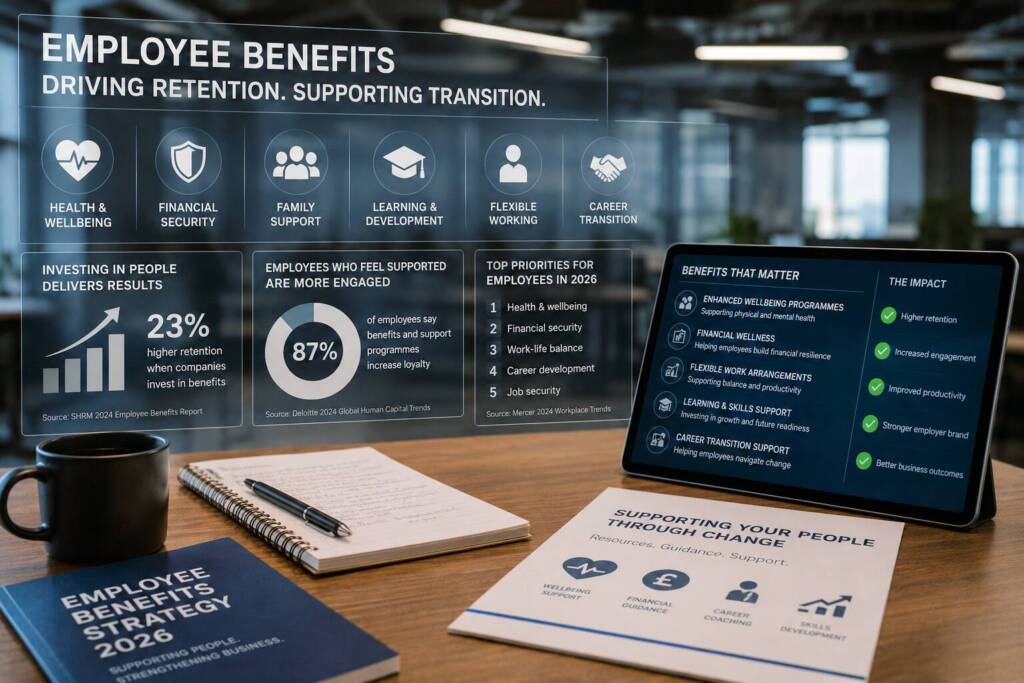
A similar disconnect appears in relation to employee benefits. While 66% of HR leaders said they had expanded their benefits offering over the past year, only 29% of employees said they had noticed any improvement. Almost half said their benefits had remained unchanged, while one in ten believed their benefits had actually been reduced.
Accessibility is also a major issue. Nearly half of employees (47%) said it was difficult to fully understand or use the rewards and employee benefits available to them. This suggests that the problem is not simply whether employers are investing in benefits, but whether employees can see, understand and access that support in practice.
The findings suggest that the gap is not simply about whether employers provide employee benefits, but whether those benefits are visible, relevant and easy to use. This is consistent with CIPD research, which highlights the importance of having a clear reward strategy rather than simply expanding benefits provision. If HR teams believe benefits have improved but employees do not notice the change, the investment is unlikely to improve engagement or workplace experience. For employers, the priority is therefore to close the communication and accessibility gap, and to ensure that employee benefits are aligned with what staff actually need.
Employers: What This Means
Rising HR1 redundancy notifications increase the importance of early restructuring planning and collective consultation compliance. Separately, employers should ensure employee benefits are visible, accessible and aligned with what staff actually value.
- Employers considering redundancies should plan early and check whether collective consultation and HR1 notification duties apply.
- Selection criteria, alternative roles, consultation records and decision-making should be clearly documented to reduce legal risk.
- The increase in the maximum protective award from 90 to 180 days’ pay raises the financial risk of non-compliance.
- Employers should not assume that expanding employee benefits will improve employee experience unless staff understand and can access them.
- Communication, accessibility and alignment with employee needs are critical to ensuring benefits investment has practical impact.