

Graduate Unemployment Rises as Entry-Level Opportunities Narrow
Graduate unemployment is becoming a more visible problem as new graduates enter a labour market shaped by weaker entry-level hiring, heavier competition and changing working patterns. The issue is not simply that there are fewer opportunities. It is that the first step from university into work has become harder to secure, particularly where employers expect experience, digital capability and immediate productivity from candidates applying for junior roles.
In Brief
Graduate unemployment is rising as entry-level opportunities narrow, competition increases and remote or hybrid working changes how employers train and support early-career staff. Separately, new research suggests that HR professionals continue to face serious levels of burnout, poor mental health and inadequate workplace support.
Key Points
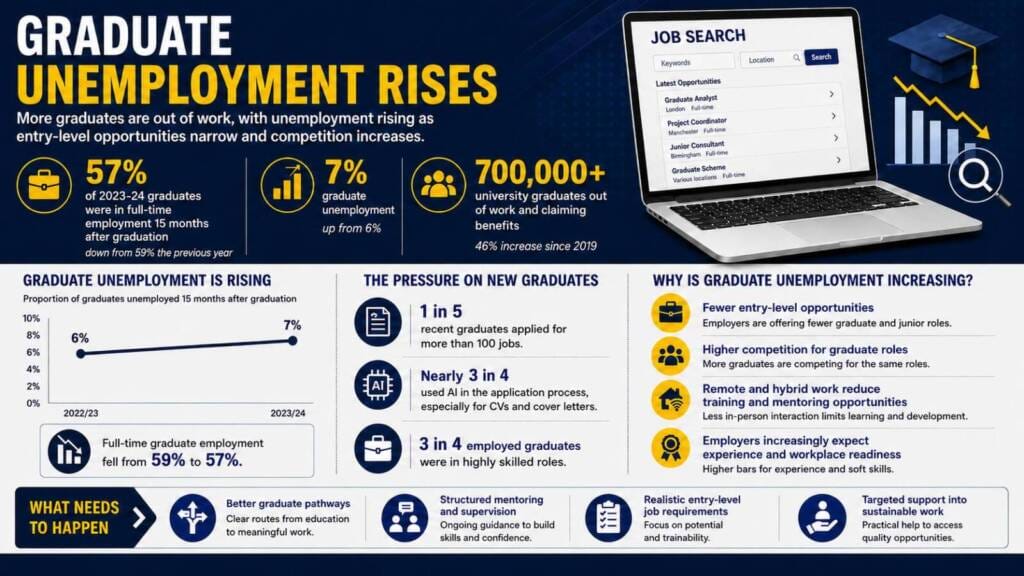
- Only 57% of 2023-24 graduates were in full-time employment 15 months after graduation, down from 59% the previous year.
- Graduate unemployment rose from 6% to 7%, with outcomes affected by factors including disability, subject choice, location, work experience and access to suitable entry-level roles.
- One in five recent graduates reported applying for more than 100 jobs, highlighting the intensity of competition in the graduate jobs market.
- Remote and hybrid working may make it harder for employers to train, supervise and mentor inexperienced staff, increasing the need for structured early-career support.
- Separate research found high levels of burnout, low mood, depression and anxiety among HR professionals.
Graduate unemployment also reflects a wider shift in how early careers are developing. Remote and hybrid working, artificial intelligence, economic uncertainty and reduced entry-level recruitment are changing the way employers train, supervise and assess new starters. For many graduates, the challenge is no longer just obtaining a degree, but proving that they can move quickly from academic study into practical workplace performance.
Graduate Unemployment and Fewer Graduates in Full-Time Work
Recent data from the Higher Education Statistics Agency shows a more difficult graduate labour market. According to HESA, 57% of 2023-24 graduates were in full-time employment 15 months after graduation, down from 59% the previous year. Graduate unemployment also increased, rising from 6% to 7%.
There are still positive signs. Around three-quarters of employed graduates were working in highly skilled roles, with science graduates among those most likely to secure such positions. This suggests that many degrees continue to provide a route into skilled employment, particularly where courses are closely linked to professional, technical or scientific occupations.
However, graduate unemployment is not experienced evenly. Graduates with disabilities reported lower rates of full-time employment, at 50%, compared with 58% for those without known disabilities. They also faced higher unemployment rates. Women were slightly less likely than men to be in full-time work, although they also faced marginally lower unemployment.
These figures show that graduate outcomes depend on more than qualifications alone. Subject choice, location, disability, health, work experience, employer networks and access to suitable entry-level roles all influence whether a graduate moves quickly into work.
Competition for Graduate Jobs Intensifies
Separate research from Prospects at Jisc highlights how competitive graduate recruitment has become. One in five recent graduates reported applying for more than 100 jobs, a figure that has nearly doubled year-on-year. That level of application activity points to a market in which candidates feel compelled to apply widely, often with limited feedback or success.
Graduate unemployment can therefore become self-reinforcing. The longer graduates remain outside work, the harder it may be to compete with candidates who have already gained experience. Employers may then favour applicants with internships, placements or previous employment, even for roles described as entry level.
Artificial intelligence is also becoming part of the job search. Nearly three-quarters of respondents to the same survey said they had used AI at some stage of the recruitment process, particularly for CVs and cover letters. This may help candidates produce more polished applications, but it may also increase the volume of similar applications employers receive.
For employers, graduate unemployment creates a practical problem as well as a social concern. Recruitment processes may need to distinguish more carefully between generic AI-assisted applications and candidates who can demonstrate genuine suitability, motivation and workplace potential.
Remote Work and Early-Career Development
Artificial intelligence is often blamed for pressures on entry-level jobs, but it is not the only factor. Research from the Federal Reserve Bank of New York has pointed to remote work as a significant contributor to rising youth unemployment in the United States. The concern is that remote and hybrid working can make it harder for managers to train, mentor and supervise inexperienced employees.
That matters for graduate unemployment because remote and hybrid teams can be harder places for new starters to learn. Employers may be more cautious about hiring graduates if they believe those graduates will need regular guidance, feedback and supervision from a distance. As a result, they may favour candidates who already have workplace experience and can operate with less support.
The effect may be strongest in white-collar sectors, where remote and hybrid work are most common. Early-career employees often learn through observation, informal conversations and immediate correction. When those opportunities are reduced, the development gap can widen.
The long-term risk is that graduate unemployment becomes not only a short-term labour market issue, but a skills pipeline problem. If fewer graduates obtain early experience, fewer will be ready for mid-level roles in future.
Graduate Unemployment and the Rise in Benefit Claims
The personal impact of graduate unemployment is reflected in the sharp rise in graduates claiming benefits. The Centre for Social Justice has reported that more than 700,000 university graduates are now out of work and claiming benefits, a 46% increase since 2019. Behind that figure are graduates applying for large numbers of jobs, receiving limited responses and, in some cases, turning to Universal Credit as a last resort.
Graduate unemployment has a personal cost as well as an economic one. It can affect confidence, mental wellbeing, financial independence and the ability to build a stable career.
The pressure is particularly acute where traditional entry routes have weakened. Hospitality, retail and leisure have often provided early work experience for young people, but rising costs and business pressures have reduced opportunities in parts of those sectors. When those first jobs disappear, graduates have fewer ways to build references, workplace discipline and interview technique.
The Need for Better Graduate Pathways
The government has announced measures aimed at tackling youth unemployment, including job creation schemes, expanded apprenticeships and targeted employment support. Those initiatives may help, particularly where they create genuine routes into sustainable work rather than just short-term placements with limited progression.
However, reducing graduate unemployment will require more than encouraging graduates to apply for more jobs. Employers also need to consider how entry-level roles are designed. If junior employees are expected to work remotely or on a hybrid basis from the outset, there must be proper mentoring, feedback, supervision and integration into the workplace.
Employers cannot solve graduate unemployment alone, but they can influence whether early-career roles remain accessible. Clear training plans, realistic job requirements and structured supervision can make graduate recruitment less risky for both sides.
Graduate unemployment should therefore be treated as a workforce planning issue, not just a graduate problem. Graduate unemployment is being shaped by economic conditions, recruitment practices, remote work, employer caution and changing skills needs. A better response requires universities, employers and policymakers to focus on the first step into work, not just the qualification that comes before it.
Burnout Remains High Among HR Professionals
New research from Ultimate Resilience / Everywhen suggests that HR professionals continue to face serious levels of burnout, stress and poor mental health. The survey of 1,447 HR professionals found that 74% were either very likely to be experiencing burnout or at risk of burnout, while the same proportion reported low mood or symptoms of depression.
The survey also revealed that 44% met the criteria for clinically significant depression, more than twice the reported rate in the general population. Anxiety was also widespread, with 73% reporting symptoms and 40% meeting clinical thresholds.
Excessive workload was identified as the leading cause of stress, cited by 52% of respondents. This reflects the pressure on HR teams to manage employee relations, disputes, restructures, sickness absence, wellbeing issues and compliance, often while supporting others through difficult workplace situations.
Moreover, just 24% of HR professionals reported receiving any wellbeing-related support, despite evidence that support reduces negative outcomes. Overall wellbeing remains low, with 63% reporting poor scores, and nearly two-fifths considering leaving the profession.
The findings underline the need for employers to address HR workload, resourcing and mental health support. Those responsible for supporting the workforce should not be left without meaningful support themselves.
Employers: What This Means
Employers should treat graduate unemployment as a workforce planning issue, not simply a problem for graduates to solve. Separately, organisations should recognise that HR professionals also need proper support, particularly where they are expected to manage complex employee relations and wellbeing issues for others.
- Review entry-level roles to ensure requirements are realistic and do not unnecessarily exclude capable graduates without extensive prior experience.
- Provide structured mentoring, supervision and feedback for graduates, especially where remote or hybrid working is part of the role.
- Use recruitment processes that identify genuine suitability and potential, rather than relying heavily on high-volume applications or AI-polished CVs.
- Assess HR workload, resourcing and mental health support so that those responsible for supporting employees are not left unsupported themselves.