
OpenAI Foundation Funds Research into AI’s Impact on Jobs
The OpenAI Foundation has announced a $250 million commitment to examine AI’s impact on jobs, communities and economic security. The funding will be distributed through grants, partnerships and direct research initiatives, with the aim of producing practical evidence on how artificial intelligence is reshaping work and how societies can respond.
In Brief
The OpenAI Foundation has announced a $250 million commitment to research AI’s Impact on Jobs, communities and economic security. Separately, a government-commissioned review led by Alan Milburn has warned that the UK Neet population could rise to 1.25 million by 2031.
Key Points
- The OpenAI Foundation’s funding will support research, grants, partnerships and direct programmes focused on AI’s Impact on Jobs.
- A key aim is to improve how AI’s Impact on Jobs, wages, workforce structures and local economies is measured.
- The initiative recognises that AI’s Impact on Jobs may involve changes to job design, skills requirements, job quality and worker agency, not just headcount.
- The Foundation’s work may also feed into wider debates about productivity, shorter working weeks, income support and how the benefits of AI should be shared.
- The Milburn review warns that the number of young people who are not in education, employment or training could reach 1.25 million by 2031.
- The review links the predicted rise to fewer entry-level roles, reduced apprenticeship opportunities and weaknesses in education, welfare and employment support.
This latest announcement sits within a wider debate about AI adoption, productivity and workforce change. Employers are investing heavily in AI, but the evidence remains mixed on whether that investment is translating into organisation-wide productivity gains.
AI's Impact on Jobs: Measuring the Evidence
A central part of the funding will support independent measurement and forecasting. This includes work to improve how AI’s impact on jobs, wages, workforce structures and local economies is assessed.
That matters because the pace of AI adoption has created significant uncertainty. Employers, policymakers and workers need better evidence on where disruption is most likely, which sectors may be most exposed, and where AI may complement rather than replace human labour. Without reliable measurement, it is difficult to distinguish between genuine structural change and short-term speculation about AI’s impact on jobs.
The Foundation’s focus also reflects the fact that AI’s impact on jobs cannot be assessed solely by asking which tasks can be automated. The more difficult question is how AI changes job design, skills requirements, workforce structures and the quality of work itself.

This is particularly important given the growing concern about AI-related redundancies. Some employers have already moved too quickly in treating AI as a substitute for human capability, only to encounter operational gaps, lost skills and later rehiring costs.
The OpenAI Foundation’s approach suggests that the debate must move beyond simple predictions of job losses. AI’s impact on jobs is likely to vary significantly by sector, role, skill level and location. Some workers may see routine tasks reduced, while others may need to develop new skills to work effectively alongside AI systems.
Supporting Workers and Communities
Part of the Foundation’s commitment will support workers and communities facing disruption from AI. This may include projects focused on reskilling, local labour market resilience, economic security and access to meaningful work.
That wider focus is important because AI’s impact on jobs will not be evenly distributed. Some workers may see their roles enhanced, while others may face displacement, reduced bargaining power or pressure to adapt quickly to new systems. Communities that depend heavily on particular sectors or types of work may also be more exposed if AI changes demand for labour.
The Foundation has indicated that it is interested not only in job displacement, but also in job quality, access to meaningful work and worker agency. That is a useful shift, because AI’s impact on jobs is not only about how many roles disappear or emerge. It is also about whether future work remains secure, purposeful and fairly rewarded.
Exploring New Economic Models
The Foundation will also support research into longer-term economic questions, including how the benefits of AI-driven productivity should be shared. This is where the announcement connects to broader policy debates around taxation, public wealth funds, shorter working weeks and income support.
If AI produces large productivity gains while reducing demand for some types of labour, questions around shorter working weeks, an AI tax, a universal basic income, and other economic security models are likely to become more prominent.
These are no longer abstract issues if AI’s impact on jobs begins to reshape whole sectors rather than individual tasks.

Direct Programmes and Partnerships
Unlike some grant-making organisations, the OpenAI Foundation intends to operate some programmes directly as well as funding external organisations. Grants are expected to support a range of partners, including researchers, non-profits, community organisations and others able to contribute practical insight.
The first funded initiatives are expected to be announced later this year, alongside the development of an internal team focused on programme delivery. This suggests the Foundation is not only seeking academic analysis of AI’s impact on jobs, but also practical projects capable of informing real-world policy and workforce responses.
Why This Matters
The scale of the commitment shows that AI’s impact on jobs is now being treated as a major economic and social issue, not simply a technology trend. For employers, the message is that AI adoption should not be viewed purely as an efficiency project or route to headcount reduction. Its effect on roles, skills, consultation, training, wellbeing and local communities will need to be considered from the outset.
The OpenAI Foundation’s initiative therefore adds to a growing body of evidence that AI-driven change must be managed carefully. The key challenge will be ensuring that AI improves productivity and creates opportunity, while reducing the risk that workers and communities bear the costs of transition without sharing fairly in the benefits.
Neet Population Predicted to Reach 1.25 Million by 2031
Report
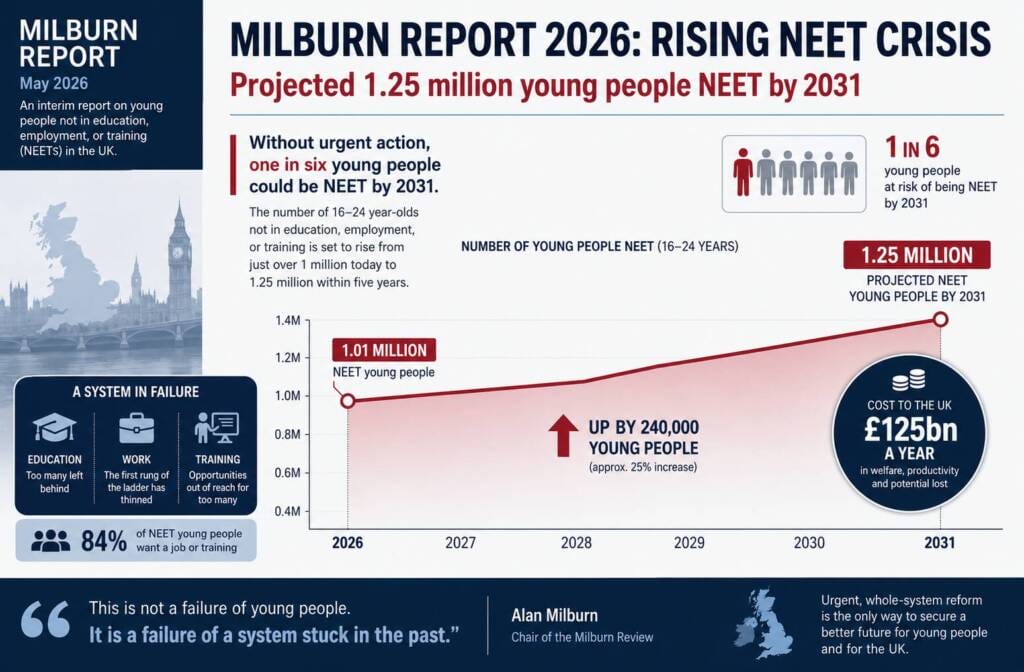
An interim report, part of a government-commissioned review led by Alan Milburn, warns that the number of young people in the UK who are not in education, employment, or training (known as 'Neet') could rise to 1.25 million by 2031. This would represent around one in six people aged 16 to 24 and a potential 25% increase on current levels.
Reasons For Increase
The review points to several factors behind this trend. These include the loss of around 1.6 million low- and medium-skilled jobs compared with previous decades, as well as a sharp decline in entry-level roles in sectors such as hospitality, leisure, and retail. As these opportunities have narrowed, more young people have found it difficult to gain an initial foothold in the labour market.
The report also shows that six in ten young people classified as Neet have never had a job, compared with four in ten two decades ago. At the same time, apprenticeship opportunities for young people have fallen by 35% over the past ten years. According to the review, existing systems, including education, welfare, and employment support, are not doing enough to prepare young people for work or help them access suitable opportunities.
A further concern is the way public spending is currently allocated. The review argues that government support remains heavily weighted towards benefits rather than proactive employment assistance, limiting the chances of helping young people move into work before long-term inactivity becomes entrenched.
Reaction
In response, the government has announced measures including incentives for employers to hire long-term unemployed young people and plans to expand apprenticeship programmes. It is also considering wider employment and welfare benefits reforms aimed at shifting more support towards helping young people into work, rather than relying primarily on benefit payments. However, business groups have warned that rising employment costs could make employers less willing to create entry-level positions.
Overall, the review calls for urgent systemic reform to prevent youth economic inactivity from worsening and to ensure more young people can make a successful transition into the labour market.
Employers: What This Means
Employers adopting AI should treat it as a workforce planning, consultation and skills issue, not simply a cost-saving tool. Separately, the projected rise in young people who are Neet highlights the importance of maintaining entry-level routes into work.
- Assess how AI may affect roles, duties, workload, skills requirements and job quality before making workforce changes.
- Where AI leads to restructuring or redundancies, follow fair procedures, consult properly and document the business rationale.
- Consider training, redeployment and upskilling before treating AI as a substitute for existing employees.
- Review apprenticeships, work experience and entry-level recruitment as part of longer-term workforce planning.