

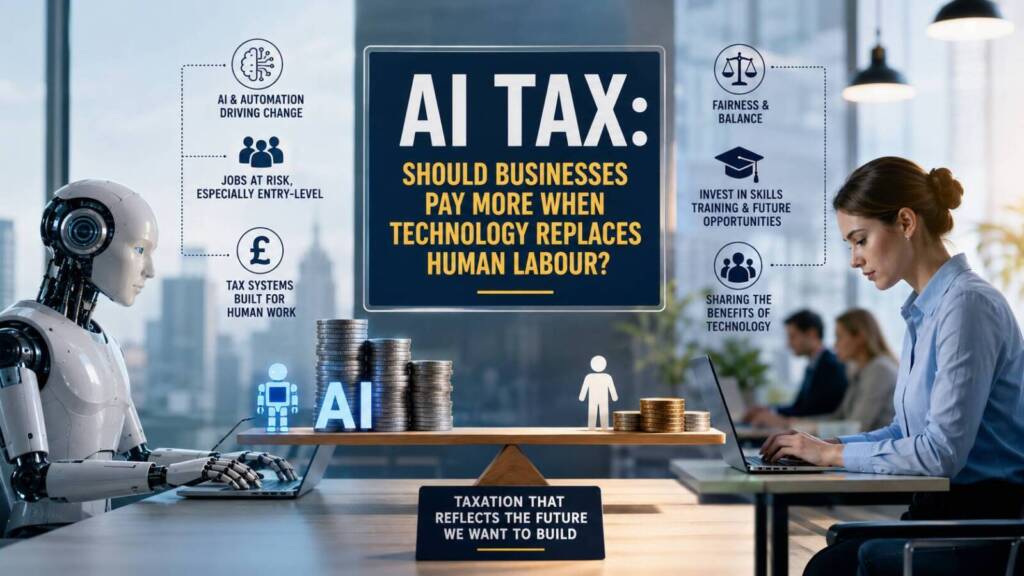
The Treasury is reportedly examining whether an AI tax or wider tax reforms could replace revenue lost if artificial intelligence causes widespread job losses. According to The Telegraph's report of 14 November, officials working under Chancellor John Healey are assessing the potential impact on income tax and National Insurance receipts, including whether more revenue should be raised from capital and corporate profits.
In Brief
An AI tax is reportedly under examination at the UK Treasury, because income tax and National Insurance rely heavily on wages that AI could reduce. No specific AI tax has yet been proposed.
Key Points
- The Telegraph reported on 14 November 2026 that the AI Economics Institute, set up in June, is assessing whether new taxes would be needed if AI causes large-scale job losses.
- In an illustrative OBR scenario, the wage share of GDP halves to 20% by 2075–76 and tax receipts fall by nearly four percentage points of GDP, with no fall in economic output.
- Options discussed by economists and campaigners include levies on AI use, excess profits taxes and higher corporation or capital gains tax; none is a Treasury proposal.
- IMF economists have warned that a direct AI or robot tax could deter investment, and that profits can move abroad, limiting what higher corporation tax would raise.
- ONS figures for September 2026 show 6% of AI-using businesses with ten or more employees cut headcount because of AI, while 52% of finance chiefs surveyed by Deloitte expect to do so within a year.
The work remains contingency planning, not an announced AI tax. The newspaper identifies no agreed model, rate or implementation date. Its sources suggest there may be about five years to prepare before labour market disruption becomes clearer.
What the Government Is Examining
The AI Economics Institute, established in June 2026, provides the research framework for this work. Its published remit covers productivity, employment, wages and the distribution of AI's economic benefits. It develops scenarios to inform government decisions but is not a policy-setting body.
The Telegraph reports that the institute is examining whether an AI tax or a broader shift away from taxing employment towards taxing capital might be needed if labour market disruption becomes severe.
Why AI Could Reduce Tax Receipts
The Office for Budget Responsibility's July 2026 analysis explains why an AI tax is being debated. In its illustrative scenario, wages and salaries have an average effective tax rate of 46% over the projection, compared with 27% for profits. If more national income moves from wages to profits, tax receipts could fall even without a reduction in the economy's overall output. Job losses could also increase spending on benefits and retraining.
In an illustrative adverse scenario, the OBR modelled the wages and salaries share of gross domestic product (GDP) falling from 40% in 2030–31 to 20% in 2075–76. With GDP held unchanged relative to its baseline, total tax receipts would fall below 35% of GDP, nearly four percentage points below the baseline.
This is not a forecast that half of all jobs will disappear. The smaller wage share could reflect job losses or weaker employee bargaining power, and the scenario assumes unchanged effective tax rates. The OBR also recognises that AI could complement employees' work, raise productivity and create new jobs. The fiscal outcome depends on the balance between these effects and who receives the resulting income.
What Form Could an AI Tax Take?
An AI tax could mean several different things. Proposals discussed by economists and campaigners include charges on owning or using AI, a levy on services provided by AI systems, taxes on excess profits, and changes to corporation tax or capital gains tax. These are alternative approaches, not an agreed Treasury shortlist.
The distinction matters. Taxing the use of technology could increase costs for employers deploying AI to assist staff as well as those replacing jobs through automation. Taxing profits or capital income would instead focus on the financial returns, without necessarily requiring a separate charge on each AI system.
The New Contract, backed by unions including GMB, argues that tax policy should not encourage businesses to replace employees with machines. Its campaign calls for capital gains tax reform and wider consideration of welfare, retraining and worker representation. Rishi Sunak also argued in March for reducing taxes on employment and raising the revenue elsewhere.

The Risks of Taxing AI Directly
IMF economists cautioned in 2024 against a direct AI tax or robot tax, warning that it could discourage investment, slow innovation and be difficult to administer. They proposed reconsidering incentives that favour labour displacement and strengthening taxation of capital income and excess profits, while supporting displaced workers.
An April 2026 IMF staff note adds that higher corporation taxes alone might not replace lost employment revenues. Profits and investment can move across borders, and countries compete to attract them. Its authors favour international co-operation and better taxation of capital income and excess returns rather than blunt taxes on technology.
For the UK, one difficulty is that AI profits may accrue to overseas suppliers. The Telegraph reports that officials have discussed international co-ordination along the lines of the global minimum corporate tax. They are also wary of taxing a growing industry too early or making the UK less attractive to AI investment and talent. Any AI tax would need to protect revenue without simply driving investment or taxable activity elsewhere.
What the Latest Evidence Shows
Whether an AI tax is needed depends partly on the scale of job losses, which remains uncertain. Government research published on 29 October, based on interviews with 3,503 businesses between January and April 2026, found that 32% were using AI, compared with 16% in 2025. Half of adopters reported an overall productivity increase, generally described as modest. The report characterised AI primarily as supporting existing activities rather than transforming business models.
ONS figures for September show that 6% of AI-using businesses with ten or more employees reported reducing headcount as a result, while fewer than 1% reported an increase. Expectations are different: an October Deloitte survey found that 52% of 66 finance chiefs at major UK companies expected AI to reduce headcount in their businesses within 12 months. These surveys measure reported experience and expectations respectively, not the same outcome.

The Future of an AI Tax in the UK
The question is not simply whether AI will replace jobs, but whether a tax system reliant on employment income can withstand a lasting shift towards corporate profits. The Treasury's reported work recognises that public revenue could come under pressure even if economic output increases. For now, an AI tax remains one possible response rather than government policy. Any eventual decision will depend on evidence of sustained labour market disruption and whether the resulting economic gains can be taxed without undermining investment.
Employers: What This Means
An AI tax remains a possibility rather than government policy. For employers introducing AI, the immediate legal considerations concern any resulting changes to employees' roles or potential redundancies.
- Replacing roles with AI: Where AI removes the need for an employee's role, this can constitute a genuine redundancy. Employers must follow a fair process, consult affected employees and consider suitable alternative employment. Eligible employees with at least two years' continuous service are generally entitled to statutory redundancy pay.
- Collective consultation: Proposing 20 or more redundancies at one establishment within 90 days triggers collective consultation. Consultation must begin at least 30 days before the first dismissal, or 45 days where 100 or more redundancies are proposed. Since April 2026, failures can result in protective awards of up to 180 days' pay per affected employee. A further organisation-wide threshold is planned for April 2027, although the number of redundancies required to trigger consultation has not yet been set.
- Unfair dismissal from 2027: From 1 January 2027, employees can claim ordinary unfair dismissal after six months' service, and the statutory cap on compensatory awards will be removed. Employers planning AI-related restructuring should account for the increased potential exposure to unfair dismissal claims.
- Tax position: Employer National Insurance remains at 15% on earnings above the £5,000 annual secondary threshold, subject to applicable reliefs. Unlike employee wages, expenditure on AI systems does not itself attract employer National Insurance, although ordinary business taxes still apply.

