

Automation, artificial intelligence (AI), and rapid technological change are transforming the modern workplace at an unprecedented pace. Roles that once seemed secure are increasingly vulnerable to automation, while entirely new categories of work are emerging. According to the World Economic Forum, nearly half of all existing job skills are expected to change significantly by the end of this decade as technological adoption accelerates across industries. In this environment, long-term career resilience will depend less on any single profession and more on developing adaptable, high-value skills that complement rather than compete with technology.
Key Points
- Automation and artificial intelligence are expected to reshape many existing job roles over the next two decades.
- Future career resilience will depend increasingly on adaptable, transferable skill sets rather than any single profession.
- Human-centred capabilities such as emotional intelligence, creativity, and communication will remain difficult to automate.
- Digital literacy and technological awareness will be essential across most industries as workplaces become more technology-driven.
- Continuous learning and adaptability will be critical as job requirements evolve in response to technological change.
- Individuals who combine technical awareness with strong human skills will be best positioned to thrive in the future labour market.
The key question is no longer simply what job to choose, but which skills and capabilities will remain valuable as machines take on more routine tasks.
Skills
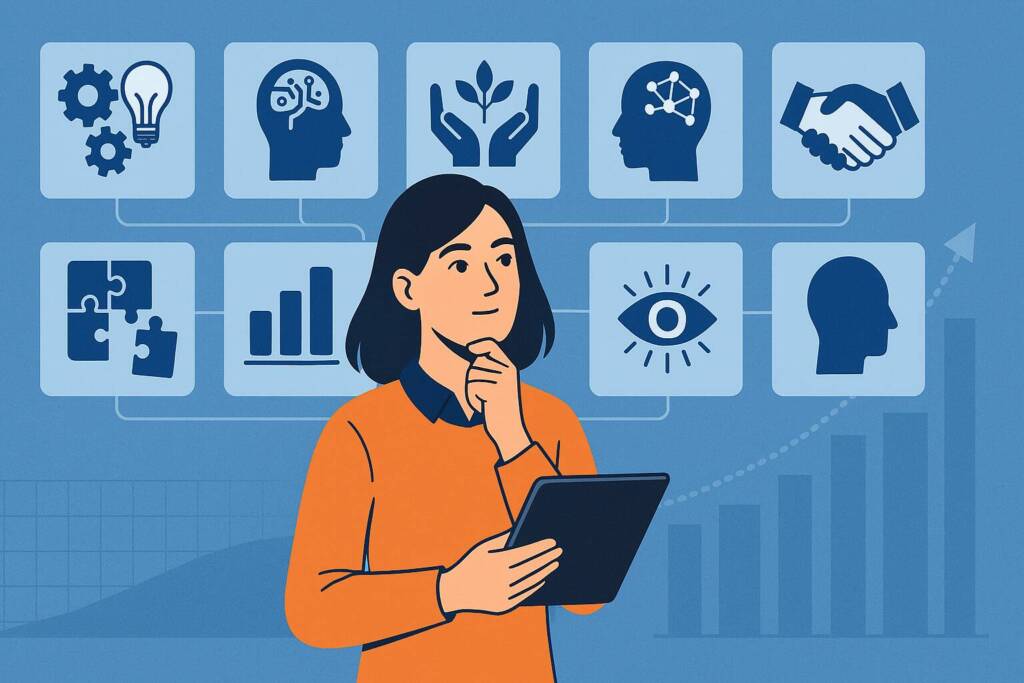
Against this backdrop, the following ten skills are among the most important for future-proofing careers over the next 10–20 years:-
- Complex Problem Solving Skills: As automation and artificial intelligence take over repetitive and predictable tasks, the ability to tackle complex and ambiguous problems will become increasingly valuable. Machines excel at following rules and processing large datasets, but they often struggle with situations that require holistic thinking, creativity, and human judgment. Complex problem solving involves identifying underlying issues, analysing multiple variables, evaluating alternative approaches, and developing practical solutions in uncertain environments. These capabilities are particularly valuable in fields such as management consulting, engineering, healthcare diagnostics, urban planning, and crisis management. Individuals who can combine analytical thinking with practical insight will remain highly valuable in organisations, helping to solve problems that technology alone cannot address.
- Emotional Intelligence (EQ): Emotional intelligence refers to the ability to recognise, understand, and manage both your own emotions and those of others. As more technical tasks become automated, interpersonal skills will increasingly differentiate high-performing professionals. Roles involving leadership, negotiation, customer relationships, education, healthcare, and team management all rely heavily on empathy, communication, and trust-building. Professionals with strong emotional intelligence are better able to manage conflict, motivate teams, and navigate organisational change. As workplaces become more diverse, global, and collaborative, the ability to understand different perspectives and manage complex interpersonal dynamics will remain a critical advantage that machines cannot easily replicate.
- Creativity and Innovation: While artificial intelligence can analyse patterns and generate content based on existing data, genuine creativity remains largely a human capability. Creativity involves generating new ideas, approaching problems from fresh perspectives, and developing innovative solutions that have not previously existed. Industries such as technology development, product design, marketing, media production, and scientific research all depend heavily on creative thinking. Individuals who cultivate creativity will be well positioned to lead innovation within organisations or to launch entirely new ventures that take advantage of emerging technologies. In a world increasingly shaped by automation, the ability to imagine new possibilities will remain a powerful driver of economic and professional value.
- Adaptability and Learning Agility: The pace of technological change means that job roles and the required skills will continue to evolve rapidly. Adaptability, the ability to adjust to new circumstances and acquire new skills quickly, is therefore essential for long-term career resilience. Learning agility allows individuals to transition between roles, industries, or technologies as market demands shift. This is particularly important in sectors such as information technology, biotechnology, financial services, logistics, and education technology, where innovation cycles are rapid. Professionals who actively pursue continuous learning through training, certifications, and practical experience will be far better positioned to navigate career transitions and remain competitive in a constantly changing labour market.
- Digital Literacy and Technological Awareness: Digital literacy has become a foundational skill across nearly every profession. However, modern digital literacy extends far beyond basic computer competence. It includes understanding data analytics tools, cloud platforms, collaboration software, cybersecurity principles, social media strategy, and increasingly, the basics of coding and automation. As organisations continue to digitise their operations, employees who understand how technology shapes workflows will have a significant advantage. Whether in marketing analytics, project management, finance, or operations, the ability to work effectively alongside digital tools and emerging technologies will be essential for productivity and career advancement.
- Critical Thinking: Critical thinking involves analysing information objectively, evaluating evidence from multiple sources, and making well-reasoned judgments. In an era where vast amounts of information, and misinformation, are available online, the ability and skills to assess credibility and interpret complex data is increasingly important. As artificial intelligence systems become more widely used in decision-making processes, professionals must also be able to question and interpret algorithmic outputs. Fields such as healthcare, journalism, finance, and public policy particularly depend on strong critical thinking to avoid errors caused by flawed data or automated recommendations. Individuals who can combine analytical rigour with independent judgment will remain essential in organisations that rely on accurate and responsible decision-making.
- Collaboration Across Cultures: Globalisation and remote working have transformed how teams operate. Professionals increasingly collaborate with colleagues, clients, and partners across different countries, cultures, and time zones. Cross-cultural collaboration requires strong communication skills, cultural awareness, and the ability to adapt one’s working style to different contexts. Understanding diverse perspectives can improve creativity, strengthen relationships, and help organisations expand into new markets. Professionals with the skills to bridge cultural differences and facilitate effective international collaboration will be highly valuable in sectors such as global business development, supply chain management, international law, and multinational technology companies.
- Judgment and Decision Making: Although automation can analyse vast quantities of data, it often lacks the contextual understanding required for nuanced decisions. Human judgment remains critical when decisions involve ethical considerations, uncertainty, or competing priorities. Leaders and professionals in areas such as healthcare, finance, government policy, and product development must regularly make decisions that require balancing complex factors. The ability to evaluate risks, interpret evidence, and consider long-term consequences ensures that human oversight remains an essential complement to automated systems.
- Entrepreneurial Mindset: An entrepreneurial mindset is no longer relevant only for founders of start-ups. Increasingly, organisations value employees who demonstrate initiative, creativity, and the ability and skills to identify new opportunities. This mindset involves recognising emerging trends, taking calculated risks, finding practical solutions to complex challenges, and learning from failure. In rapidly changing markets, individuals who think entrepreneurially can help organisations innovate, launch new products, and adapt to technological disruption. Whether building a start-up or driving innovation within an established company, professionals with entrepreneurial skills and instincts often become catalysts for growth and transformation.
- Communication Skills: As workplaces become more complex, geographically dispersed, and technology-driven, strong communication skills will remain one of the most valuable capabilities for long-term career success. Effective communication involves the ability to convey ideas clearly, listen actively, and adapt messages to different audiences and contexts. In professional environments, this may include presenting complex information, writing clearly and persuasively, negotiating agreements, or collaborating across teams and disciplines. Strong communication skills are particularly important in leadership roles, client-facing professions, project management, education, and public policy. Even in highly technical fields, professionals who can translate complex concepts into clear and understandable language often become the most influential and trusted contributors within their organisations.

Building a Resilient Career in an Age of Technological Change
While automation and artificial intelligence will undoubtedly reshape the labour market over the coming decades, they are unlikely to eliminate the need for human talent altogether. Instead, the nature of work will continue to evolve, placing greater emphasis on skills that complement technological capabilities rather than compete directly with them. The most resilient careers will belong to individuals who combine technical awareness with distinctly human strengths such as creativity, judgment, emotional intelligence, and complex problem-solving.
Importantly, future-proofing a career is not about mastering every emerging technology. Rather, it involves cultivating a mindset of continuous learning and adaptability. As industries transform and new roles emerge, those who are willing to acquire new skills, embrace change, and remain intellectually curious will be best positioned to thrive.

Equally, many of the skills identified above are transferable across sectors. Communication, critical thinking, collaboration, and adaptability are valuable skills whether one works in technology, healthcare, business, education, or the public sector. By investing in these capabilities, professionals can build careers that remain flexible and resilient even as the economic landscape shifts.
Ultimately, while machines will increasingly handle routine and predictable tasks, human ingenuity, judgment, and interpersonal understanding will continue to play a central role in shaping the future of work.
Employers: What This Means
- Employers should invest in workforce training programmes that prioritise adaptable and transferable skills rather than narrow technical competencies.
- Organisations may benefit from encouraging continuous professional development to help employees adapt to rapidly changing technologies.
- Recruitment strategies should place greater emphasis on soft skills such as communication, critical thinking, and collaboration.
- Businesses that support learning agility and innovation within their workforce are more likely to remain competitive in an increasingly automated economy.

