
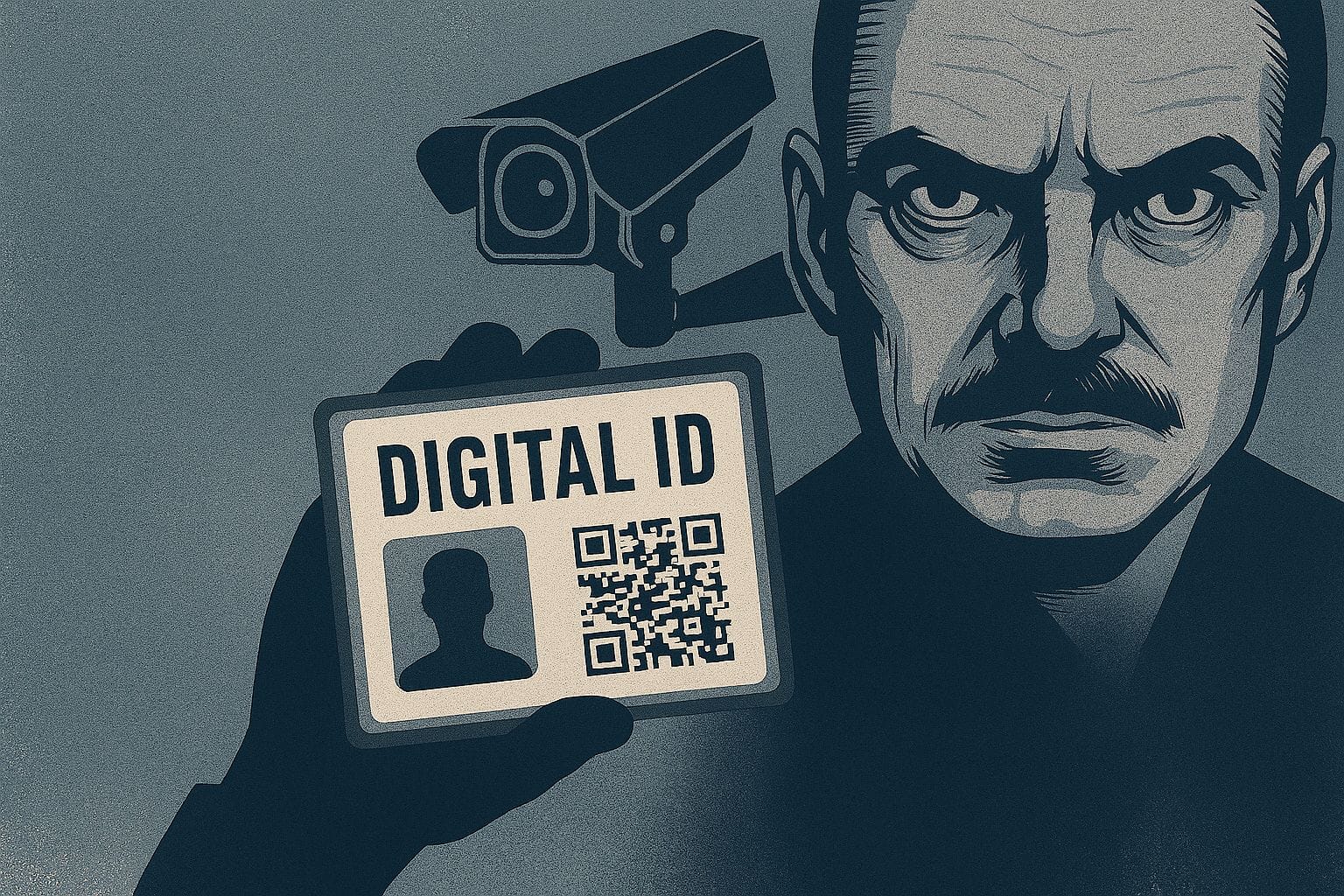
The prime minister, Keir Starmer, has stated that the government intends to introduce a digital ID scheme on the basis that it will reduce illegal migration. But would it, and what are the risks associated with such a scheme?
Digital ID
A digital ID scheme is highly unlikely to have any meaningful impact upon illegal migration. This is because:-
- The UK already operates a digital right-to-work system: foreign employees must obtain a share code through their eVisa account, which employers are legally obliged to check before hiring. These checks are enforced with significant penalties for non-compliance. Introducing another layer of digital ID would only require law-abiding employers to update procedures, while those intent on circumventing the law, by hiring off the books or ignoring checks, would continue as before. That is, the current checks have made no impact upon illegal migration, and nor will simply adding yet another layer to it which contains the exact same flaws
- Experience in countries like Germany, which has had a digital ID system since 2010, shows that illegal working persists despite such systems. The fundamental issue lies not in identification but in enforcement; digital IDs do not deter employers who knowingly break the law. Thus, Starmer’s plan risks adding bureaucracy and potential exclusion for vulnerable groups without addressing the root causes of illegal migration or employment. Existing systems already provide robust digital verification where it matters most.
Moreover, the fact of the matter is that the potential risks / downsides that would come with digital ID far outweigh any benefits. So what are the risks / downsides, and why should the proposed digital ID scheme be opposed?
Risks
The risks / downsides of a digital ID scheme include the following:-
- Mass Surveillance Infrastructure: Digital ID systems create the technical infrastructure for unprecedented monitoring of citizens’ activities. By centralising and digitising personal data, the state gains the ability to track where individuals work, access services, travel, and interact with both public and private sectors. This “panoptic” capability risks normalising surveillance in everyday life, potentially chilling free expression and dissent. Even if current intentions are benign, such a system’s mere existence enables future governments or malicious actors to exploit it for mass tracking beyond its original scope. It would represent a cultural shift away from Britain’s tradition of minimal state intrusion into private life. While proponents point out existing forms of identification (passports, driving licenses), these are not required at every turn nor centrally linked across all domains of public life. Digital ID sets a precedent for ever-expanding data collection, a step toward a future where privacy is no longer assumed but must be “granted” by those controlling the system.
- The Potential For Increased and Coercive State Control: Making digital ID mandatory for employment, and possibly in other aspects of life, shifts power fundamentally toward the state. Citizens must submit their identity to a central database as a precondition for participating in society. This dynamic can become coercive: refusal to comply means exclusion from work, benefits, or basic services. Over time, this could normalise further requirements and controls tied to one’s digital identity, eroding voluntary participation and increasing state leverage over individuals. Moreover, any powerful system designed today may be inherited by less scrupulous leaders tomorrow. Digital ID creates a ready-made apparatus that could be weaponised by an authoritarian regime: targeting dissidents, facilitating mass deportations, restricting protest rights, or enabling discrimination against minorities. As political tides shift rapidly, as seen elsewhere, Britain’s unwritten constitution offers limited protection against such abuses once the system is built.
- “Function Creep”: Experience from other countries shows that digital ID systems rarely remain confined to their initial purpose. What starts out as a tool for employment verification can expand into welfare access, voting authentication, health records management, financial transactions, or even internet access control. Each new use case increases the breadth of surveillance and the risk of unintended consequences. Function creep also makes it harder for citizens to opt out without sacrificing more aspects of daily life.
- Civil Liberties Infringements: Compulsory digital ID challenges core British civil liberties: privacy, freedom of association, and freedom from arbitrary interference by authorities. The right not to have one’s identity continually checked or recorded underpins a democratic society. Historical opposition to ID cards in Britain reflects deep-seated resistance to being monitored by the state “just in case.” Mandating digital identification undermines this tradition and risks eroding trust between citizens and government.
- Discrimination and Exclusion Risks: Millions, particularly elderly people or those with limited digital literacy, risk being left behind by a “digital by default” approach. Without careful provision for non-digital alternatives (which often prove inadequate in practice), vulnerable groups may be unable to prove their status or access essential services. This deepens social divides and could lead to practical injustices, people unable to work or claim benefits due to technical barriers beyond their control.
- A "Honeypot for Hackers": Centralised databases holding sensitive personal information are prime targets for cybercriminals and hostile states - a "honeypot for hackers" as it were. High-profile breaches in government systems worldwide demonstrate that no database is perfectly secure. A compromised digital ID system could expose millions to identity theft, fraud, blackmail, or worse - undermining public trust not just in the scheme but in government itself.
- Almost Completely Ineffective As a Means Of Reducing Illegal Working: Critics, including former officials, argue that determined employers who already ignore existing right-to-work laws will continue doing so regardless of digital ID requirements. Illegal working thrives not because of document shortcomings but due to poor enforcement and deliberate lawbreaking; adding another layer of bureaucracy burdens compliant businesses whilst failing to address the root causes of the problem.
- Erosion of Anonymity in Everyday Life: Digital ID fundamentally alters the relationship between citizen and state by making anonymity increasingly difficult in daily transactions, from renting property to accessing healthcare or applying for jobs. This loss of practical anonymity undermines individual autonomy and could foster a culture of suspicion where everyone must continually prove who they are. It brings the world of Orwell's 1984 one step closer: a society under constant surveillance, where individual freedoms and privacy are nonexistent, a "checkpoint society" where individuals are routinely required to prove their identity (leading to increased government overreach and the potential for mass surveillance), and the collection and centralisation of vast amounts of personal data with the potential for misuse for the purposes of tracking, profiling, and control. You only have to read up on the history of East Germany and the Stasi to realise that the world of Orwell's 1984 can quickly become a reality, and the sheer potential for a future Government gone rogue to misuse and abuse digital ID to make it a reality - the first domino as it were
Newspeak
The proposed digital ID has somewhat ludicrously been referred to as a "BritCard”. Well, just as a digital ID scheme can be viewed as Orwellian, the term "BritCard” can be viewed as Newspeak.

Defending Liberty, Privacy, and Democracy
The government’s proposed digital ID scheme is not just an unnecessary response to illegal migration, it is a fundamental threat to the values and freedoms that have long defined British society. The risks of mass surveillance, coercive state control, function creep, exclusion of vulnerable groups, and data insecurity are far too great to justify introducing a system that offers no meaningful benefits in tackling illegal working or migration.
Britain’s proud tradition has always been one of limited state interference and robust civil liberties. Mandating digital identification for everyday life would mark a historic departure from this legacy, laying the groundwork for an intrusive surveillance infrastructure that future governments could exploit in ways we cannot foresee. Once such a system is in place, history shows it will be nearly impossible to roll back, and all too easy for its scope to expand.
We must oppose the introduction of a digital ID scheme not only because it fails on its own terms but because it poses grave dangers to privacy, democracy, and social cohesion. The defence of our freedoms demands vigilance against any measure that would turn Britain into a “checkpoint society”, with the potential down the line for something even worse than that

