
Artificial Intelligence (AI): Possible Net Increase In Jobs
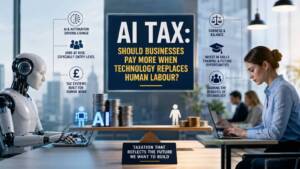
As we highlighted in a previous article, a report by Goldman Sachs back in March 2023 forecast that "generative AI could expose the equivalent of 300 million full-time jobs to automation." Nevertheless, a new report published as part of the Pissarides Review into the Future of Work and Wellbeing, has suggested that artificial intelligence (AI) may ultimately bring about a net increase in jobs.
New Report
The main findings of the new report on the impact of artificial intelligence (AI), in which over 1000 employers were interviewed, were as follows:-
- 66.6% of the respondents stated that artificial intelligence (AI) had created new roles, whilst 47.2% confirmed that some roles had been lost
- 69.3% reported that artificial intelligence (AI) improved job quality, whilst only 4.9% were of the view that quality had fallen. The report states that quality is often enhanced by "improving access to data and information and communication, creating new activities, and simplifying interactions between colleagues.....Often, the positive effect is driven by increases in productivity, job satisfaction and perceived meaning of work, as low-value menial, routine tasks are phased out."
- 83% of the employers interviewed stated that artificial intelligence (AI) required a new skill set amongst their employees, whilst 53.9% confirmed that the need for some existing skills had been eliminated by the introduction of artificial intelligence (AI)
The main conclusion of the report is that artificial intelligence (AI) could "lead to both net job creation, and more ‘good work’".
The report adds: "AI can automate many tasks and substitute human labour, but equally it may augment and complement human capabilities, enabling workers to delegate the most routine and boring work to machines and spend time on interesting, challenging, meaningful, and value-creating work."

Davenport and Miller
The findings of the Pissarides Review confirm those of earlier reports. In their 2022 book, 'Working with AI: Real Stories of Human-Machine Collaboration', for instance, Thomas H. Davenport and Steven M. Miller concluded that AI was not resulting in net job losses, as it had a tendency to augment as opposed to completely automating and taking over roles.
OECD
Furthermore, the 2023 OECD Employment Outlook report found that there was "little evidence of significant negative employment effects due to AI. Empirical studies.....do not find any statistically significant decrease in employment. Similarly, recent surveys of workers and firms, or case studies of firms adopting AI, find few employment changes."

Workers (Predictable Terms and Conditions) Act 2023
At the time of our recent update on the 2023/24 employment law changes, the Workers (Predictable Terms and Conditions) Bill, as it then was, was awaiting its 3rd reading in the House of Lords. It has now received Royal Assent (on the 18th September 2023).

The Act
Under the Act, where workers hours vary in terms of the number of hours employees work and/or when they work, or they are in a fixed term contract of less than a year’s duration, then they would be permitted (up to twice a year) to apply for a more predictable working pattern after 26 weeks of continuous service.
Reaction
Commenting upon the new legislation, Kevin Hollinrake, the Business and Trade Minister, stated: "Although zero hours contracts can often suit workers who want to work flexibly and employers whose needs vary, it is unfair for anyone to have to put their lives on hold to make themselves available for shifts that may never actually come - this Act helps to end the guessing game. A happier workforce means increased productivity, helping in turn to grow the economy, which is why we’ve backed these measures to give people across the UK more say over their working pattern."
The Head of Public Policy at the Chartered Institute of Personnel and Development (CIPD), Ben Willmott, added: "This new right will ensure that atypical workers can request a more predictable working pattern if they need more certainty, for example, over the hours they work each week."