

AI generated pleadings and legal submissions are becoming an increasingly contentious feature of Employment Tribunal litigation, particularly as more litigants in person turn to generative AI for help with pleadings, skeleton arguments and other written submissions. Their use raises obvious questions about accuracy, relevance, procedural compliance and who ultimately bears responsibility for the finished document.
In Brief
AI generated pleadings can help litigants in person organise facts, structure arguments and present their cases more clearly, but they also create significant risks where the output is inaccurate, excessive or procedurally non-compliant. Recent Employment Appeal Tribunal authority and Employment Tribunal guidance make clear that there is no general objection to using AI, but responsibility for the finished document remains with the person who files it.
Key Points
- AI generated pleadings may improve access to justice by helping litigants in person organise complex facts, identify possible issues and produce more coherent written submissions.
- Generative AI can save time and assist with structure, presentation and initial drafting, but any legal propositions, authorities or citations it produces must be independently checked.
- In Hancox v Sutherland and Others [2026] EAT 139, a litigant in person filed a ChatGPT-generated skeleton argument running to 300 pages and almost 132,000 words, before asking the respondents to identify its errors. The EAT regarded that approach as unacceptable.
- There is no general prohibition on using AI generated material in Employment Tribunal or EAT proceedings, but litigants remain responsible for ensuring their submissions are accurate, relevant and compliant with procedural requirements.
- June 2026 Presidential Guidance on interim relief applications similarly warns that AI can produce submissions that are too long, complex, irrelevant or unfocused and stresses that litigants must ensure their own material is concise, relevant and accurate.
- The ease with which AI can generate large volumes of legal-looking text creates a separate risk: overlong and unfocused submissions can obscure the strongest arguments and transfer the burden of identifying what matters to the tribunal and opposing party.
AI Generated Pleadings & Arguments
The risks were brought sharply into focus by the Employment Appeal Tribunal in Hancox v Sutherland and Others [2026] EAT 139. The appellant, who represented himself, filed a skeleton argument created using ChatGPT. It ran to 300 pages and almost 132,000 words. He then invited the respondents, effectively overnight, to identify factual inaccuracies, incorrect quotations, mistaken references and other errors.
The EAT regarded that approach as unacceptable. The document failed to comply with the requirements governing skeleton arguments and, rather than assisting the tribunal, its scale and complexity impeded preparation for the hearing. The appellant also accepted that much of it lacked credibility.
Importantly, Hancox does not establish that litigants should not use AI generated material. Marcus Pilgerstorfer KC expressly recognised that there is no general prohibition on using generative AI to assist with documents submitted to the EAT. The responsibility, however, remains with the person filing the document. AI does not transfer responsibility for checking the facts, law, authorities or relevance of the finished submission to the tribunal or the opposing party.
That approach is also reflected in the June 2026 Presidential Guidance on applications for interim relief in Employment Tribunals. The Guidance states that there is no objection in principle to using AI, but warns that it can produce submissions that are too long, complex, irrelevant or unfocused. Litigants using AI remain responsible for ensuring that what they submit is concise, relevant and accurate.
That distinction matters because AI generated pleadings can offer genuine advantages, particularly to litigants who cannot afford professional representation. Generative AI can help organise a chronology, identify possible legal issues, improve structure and presentation, and turn an unstructured account of workplace events into a more coherent legal document.
The difficulty is that polished drafting can create a false impression of reliability. AI generated arguments may sound authoritative while misstating the law, inventing authorities, misunderstanding the factual dispute or producing far more material than the case requires. The problem is therefore not simply whether the document looks professional, but whether it is accurate, relevant and procedurally compliant.
Used carefully, AI generated assistance may improve access to justice and help litigants present their cases more clearly. Used uncritically, it can create additional work for opponents and tribunals, obscure the strongest arguments and undermine the user's own case.
The real question is therefore not whether AI should have a role in Employment Tribunal litigation. It is how AI generated pleadings should be used, what advantages they offer and where their limits become significant.
Given this, we now look at the merits or otherwise of using AI generated pleadings and arguments.
Advantages
The advantages of AI generated pleadings and arguments include the following:-
- Enhanced Access to Justice for Litigants in Person: AI generated pleadings can provide useful support for individuals who cannot afford professional legal representation. By utilising generative AI, self-represented parties can access tools that help them organise their thoughts, outline their case, and translate complex workplace events into a structured legal narrative. This empowerment reduces barriers to meaningful participation in Employment Tribunal proceedings, ensuring that litigants are better equipped to present their claims or defences. The ability to generate documents quickly and present information more coherently may also help litigants in person participate more effectively in tribunal proceedings, particularly where professional representation is unaffordable.
- Improved Structure and Clarity in Submissions: One of the key strengths of AI generated material is its capacity to impose order on unstructured information. When drafting pleadings or arguments, generative AI can assist users in organising facts chronologically, identifying relevant legal issues, and presenting arguments coherently. Used carefully, this can result in submissions that are easier for tribunals and opponents to understand and engage with. Clearer documents facilitate more efficient hearings by focusing attention on the core issues in dispute, reducing ambiguity, and minimising misunderstandings that could otherwise prolong proceedings. Ultimately, this supports better decision-making by the tribunal.
- Efficiency and Time Savings: AI generated pleadings significantly reduce the time required to draft comprehensive legal documents. By assisting with the initial drafting process, such as summarising facts, suggesting a structure or reworking unclear passages, AI can enable users to produce a first draft much more quickly. This efficiency is particularly valuable where deadlines are tight or resources limited. Legal professionals may also benefit from AI assistance in preparing routine documents, freeing up time for strategic casework or client engagement.
- Assistance with Consistency and Review: AI can assist users in reviewing a draft for internal consistency, identifying possible omissions and checking whether the document addresses the issues the user intended to cover. It can also help with formatting, organisation and consistency of presentation. However, AI should not be relied upon to verify legal authorities, procedural requirements or citations, all of which require independent checking. While final responsibility remains with the user to verify the accuracy of AI generated material, some routine drafting oversights may be easier to identify by AI’s systematic approach.
- Support for Complex or Unfamiliar Legal Issues: For litigants confronting novel or complicated employment law questions, such as discrimination claims or intricate contractual disputes, AI offers preliminary guidance on possible legal frameworks and arguments. It can suggest possible legal concepts, statutory provisions or areas for further research that a layperson might otherwise overlook, although any authority or legal proposition it identifies must be independently verified. This can provide a useful starting point for those unfamiliar with tribunal processes or substantive employment law. Even experienced representatives may find AI generated material useful in brainstorming alternative arguments or identifying issues not immediately apparent from an initial review of the facts. As a result, parties are better positioned to present comprehensive cases before the tribunal.
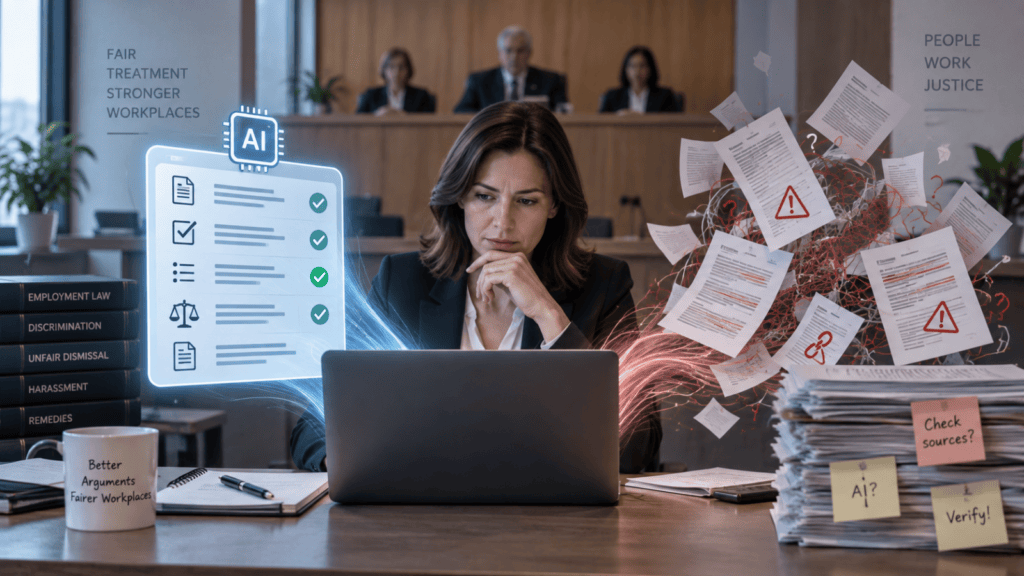
Disadvantages
However, AI generated pleadings and arguments come with problems, the main ones of which are:
- Risk of Inaccurate or Fabricated Content: AI-generated pleadings and arguments can contain factual inaccuracies, misstate the law, or even invent legal authorities and quotations. This arises because generative AI models, while proficient at producing text that appears professional and authoritative, do not possess genuine legal understanding or the ability to verify facts. As a result, users may unwittingly submit arguments based on incorrect premises or non-existent case law. In tribunal proceedings, such errors can undermine the credibility of a party’s case and waste valuable time as opponents and tribunals are forced to identify and correct these mistakes. Ultimately, reliance on unchecked AI output increases the risk of misleading submissions that fail to advance the user’s interests.
- Failure to Comply with Procedural Rules: Employment Tribunals and the EAT impose procedural requirements on pleadings and written submissions, with particularly specific requirements governing skeleton arguments in the EAT. AI tools may generate submissions that do not adhere to these requirements, such as excessive length, irrelevant content, or improper citation styles, because they lack context-specific knowledge about tribunal practice directions. Non-compliant documents can impede preparation for hearings and create administrative burdens for both parties and tribunal staff. This can result in submissions being disregarded or criticised by judges, potentially disadvantaging the party who relied on AI assistance.
- Obscuring Key Arguments with Excessive Material: While AI can efficiently generate large volumes of text, it often does so without discriminating between what is genuinely relevant and what is superfluous. This can lead to pleadings that are overly lengthy or cluttered with marginal issues, making it harder for tribunals and opponents to identify the central points in dispute. The key arguments risk being buried under unnecessary detail or tangential material. This not only complicates case management but may also weaken the user’s position by failing to focus attention on their strongest claims or defences.
- False Sense of Security from Polished Drafting: The professional appearance and coherent structure of AI-generated documents may give users, particularly litigants in person, a misplaced confidence in their accuracy and persuasiveness. This false sense of security can discourage critical review or independent verification of key facts, legal arguments, and sources cited within the submission. As a consequence, parties may present flawed cases believing they are robustly argued simply because they look well-presented, ultimately harming their prospects before the tribunal when substantive errors come to light.
- Responsibility Remains with the User: Generative AI does not absolve users of their obligation to ensure pleadings are accurate, relevant, and compliant with procedural rules. However, there is a risk that litigants, especially those without legal training, may mistakenly assume responsibility has shifted to the technology itself or even to their opponents for identifying errors. In reality, any deficiencies in an AI-drafted document remain attributable solely to its filer. Failure to appreciate this distinction can expose users to criticism from tribunals and possible adverse outcomes if submissions are found wanting due to errors introduced by AI assistance.
AI Generated Pleadings: A Tool, Not a Substitute for Judgment
AI generated pleadings are likely to become an increasingly familiar feature of Employment Tribunal litigation. Used properly, they can help litigants in person organise complex facts, improve the presentation of their case and obtain drafting assistance that might otherwise have been beyond their means. They may also save time for professional representatives when used as part of a properly supervised drafting process.
The difficulty arises when assistance becomes substitution. Generative AI can produce convincing legal language without understanding whether the argument is relevant, the authority exists or the document complies with procedural requirements. The speed with which large quantities of material can be generated also creates a particular risk of overlong and unfocused submissions, shifting the burden of identifying what actually matters onto opponents and the tribunal.
Hancox illustrates that distinction starkly. The problem was not simply that ChatGPT had been used. It was that the resulting material had not been reduced, checked and controlled before being filed.
The sensible approach is therefore neither prohibition nor unquestioning adoption. AI generated material should be treated as a drafting aid that remains subject to human judgment, verification and responsibility. As the Hancox judgment makes clear, that requires at least three things: compliance with procedural rules, proper checking for factual and legal accuracy, and a disciplined focus on relevant points and the strongest arguments. Used on that basis, it may improve access to justice. Used without those safeguards, it may make litigation less efficient rather than more.
Employers: What This Means
AI generated pleadings and legal submissions are likely to become increasingly common in Employment Tribunal litigation. Employers should be prepared for documents that may appear polished and authoritative but contain factual errors, irrelevant arguments, inaccurate authorities or excessive material. The use of AI does not shift responsibility for checking a case onto the opposing party or the tribunal.
- Do not assume that a professionally presented AI generated pleading is legally or factually reliable. Check the allegations, authorities and legal propositions relied upon in the usual way.
- Where an opposing party files excessive, irrelevant or procedurally non-compliant material, consider seeking appropriate case-management directions rather than assuming the burden of auditing or correcting their material. Any significant inaccuracies or fabricated authorities should still be raised where relevant to the employer's response.
- Keep the employer's own response focused on the real issues in dispute. Large volumes of AI generated material should not distract from preserving evidence, identifying key witnesses and addressing the strongest factual and legal points.
- If the employer or its representatives use AI as a drafting aid, ensure the final document is independently reviewed for accuracy, relevance, procedural compliance and the correctness of any legal authorities before it is filed. Solicitors and counsel are also subject to professional duties when putting material before a court or tribunal, and serious failures involving false or unchecked authorities can result in regulatory referral or wasted costs consequences.

