
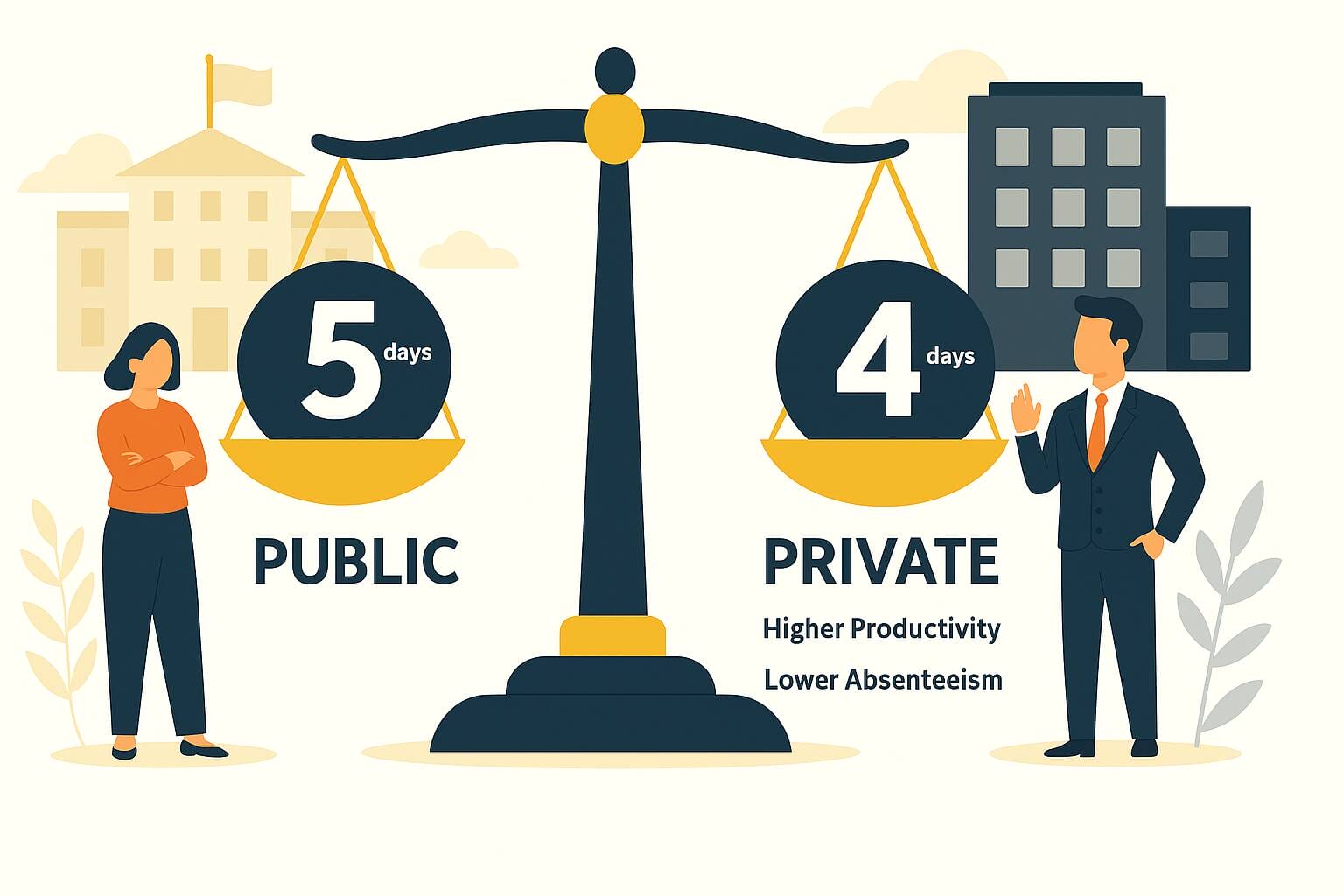
As the concept of a four-day working week gains traction in the private sector, calls to extend this innovative approach to the public sector are growing louder. Proponents argue that reducing working hours can boost morale, decrease turnover, and even improve productivity. However, recent developments, particularly at South Cambridgeshire District Council, the first local authority to formally adopt a four-day week, have brought the debate into sharp focus. Government ministers have raised concerns about declining key service metrics, while broader issues around public sector productivity and sickness absence continue to fuel skepticism.
Four-Day Working Week
The four-day working week approach is based upon what is known as the 100:80:100 model, in which employers pay their employees their full pay (i.e. 100%) despite employees only working 80% of the normal working week (i.e. a four-day working week, instead of 5). In exchange, the employee looks to deliver 100% productivity (i.e. produce what they had been doing in 5 days, in 4 days).
6 Month Trials
There have been two 6 month trials carried out in this country so far, which have highlighted the benefits of a four-day working week. The results showed improved employee wellbeing, reduced stress and burnout, better work-life balance, and enhanced physical and mental health. Companies saw maintained or increased productivity, higher talent retention, lower absenteeism, improved recruitment, and sustained long-term adoption of the reduced-hours schedule.
Participants Opt To Continue
Moreover, 92% of the 61 companies who participated in the first trial decided to continue with a four-day working week, with 89% having successfully maintained the policy a year later. Furthermore, in relation to the second trial, all 17 participating companies chose to continue with the four-day working week (or a nine-day fortnight) after their pilot ended
A Success In The Private Sector
These results highlight that in many cases in the private sector, a four-day working week is beneficial for businesses and their employees
The Public Sector
Nevertheless, the debate about whether a four-day working week should be extended to the public sector has been brought to the fore by a letter from Steve Reed, the local government secretary, to South Cambridgeshire District Council (the only local authority to adopt a four-day working week) raising performance concerns.
4 Key Problems
Whilst a four-day working week is a viable proposition for many in the private sector, critics point to 4 key problems in extended to the public sector:-
- Service Standards: In his letter to South Cambridgeshire District Council, Steve Reed stated: "The independent report shows that performance declined in key housing-related services, including rent collection, re-letting times, and tenant satisfaction with repairs, especially where vulnerable residents may be affected....If social housing is being built by this Government, and your team are unable to move residents into them so that they are standing empty, then I must reiterate my deep disappointment with your conduct." Whilst South Cambridgeshire District Council pointed out in response to alleged improvement across the Council's range of services, the dispute highlights the necessity of conducting fully independent rigorously tested pilots of a four-day working week before any area of the public sector is allowed to move onto them, so as to ensure that they are a viable proposition.
- Taxpayer Expense: One of the central objections is rooted in who ultimately foots the bill. Unlike private companies where efficiency gains or increased profits might justify shorter hours, public sector wages are paid by taxpayers. Critics argue that granting public sector employees an extra day off each week, without any reduction in pay, amounts to subsidising leisure time at taxpayers expense. Delivering value for money for taxpayers must remain paramount.
- Low Public Sector Productivity: As we highlighted in a recent article, the public sector has a long history of low productivity compared to the private sector. Whereas productivity has increased by 50% in the private sector since 1995, it has fallen back in the public sector by 20%. Indeed, it is 8.5% below the level it was at pre-pandemic. This recently prompted Andrew Bailey, the Bank of England Governor, to state: "It is fair to say we have seen an increase in public sector employment. We haven’t seen a commensurate increase in measured public sector output." Given this, it would be extremely irresponsible to permit four-day working week arrangements in the public sector until productivity parity has been attained between the public and private sectors. To do otherwise, would risk exacerbating the existing public sector low productivity issue, thereby delivering extremely poor value for the taxpayer
- High Sickness Absence Rates: The low productivity issue in the public sector is compounded further by its high sickness absence rates compared to the private sector. Indeed, a new report by the Office for National Statistics (ONS) found that the rate of sickness absence in the public sector (2.9%) was 1.1% above that of the private sector (1.8%). Hence, again it would be extremely irresponsible to permit four-day working week arrangements in the public sector until parity had been attained between the public and private sectors in terms of both productivity and sickness absence rates. To do otherwise, would place the quality of public services at risk, thereby delivering extremely poor value for the taxpayer

Balancing Innovation and Accountability
The debate over a four-day working week in the public sector encapsulates a broader tension between embracing workplace innovation and safeguarding public accountability. While private sector trials have produced encouraging results, demonstrating improvements in wellbeing, productivity, and retention, the challenges facing the public sector are distinct and deeply rooted. Concerns around declining service standards, taxpayer value, persistent productivity gaps, and higher sickness absence rates cannot be dismissed lightly.
Quite simply, if the public sector wants a four-day working week, then they need to earn it by first closing the productivity and sickness absence rate gaps with the private sector. Policymakers must then ensure that pilot schemes are rigorously and independently assessed against clear benchmarks for service delivery and cost-effectiveness, so as to ensure value for the taxpayer.

